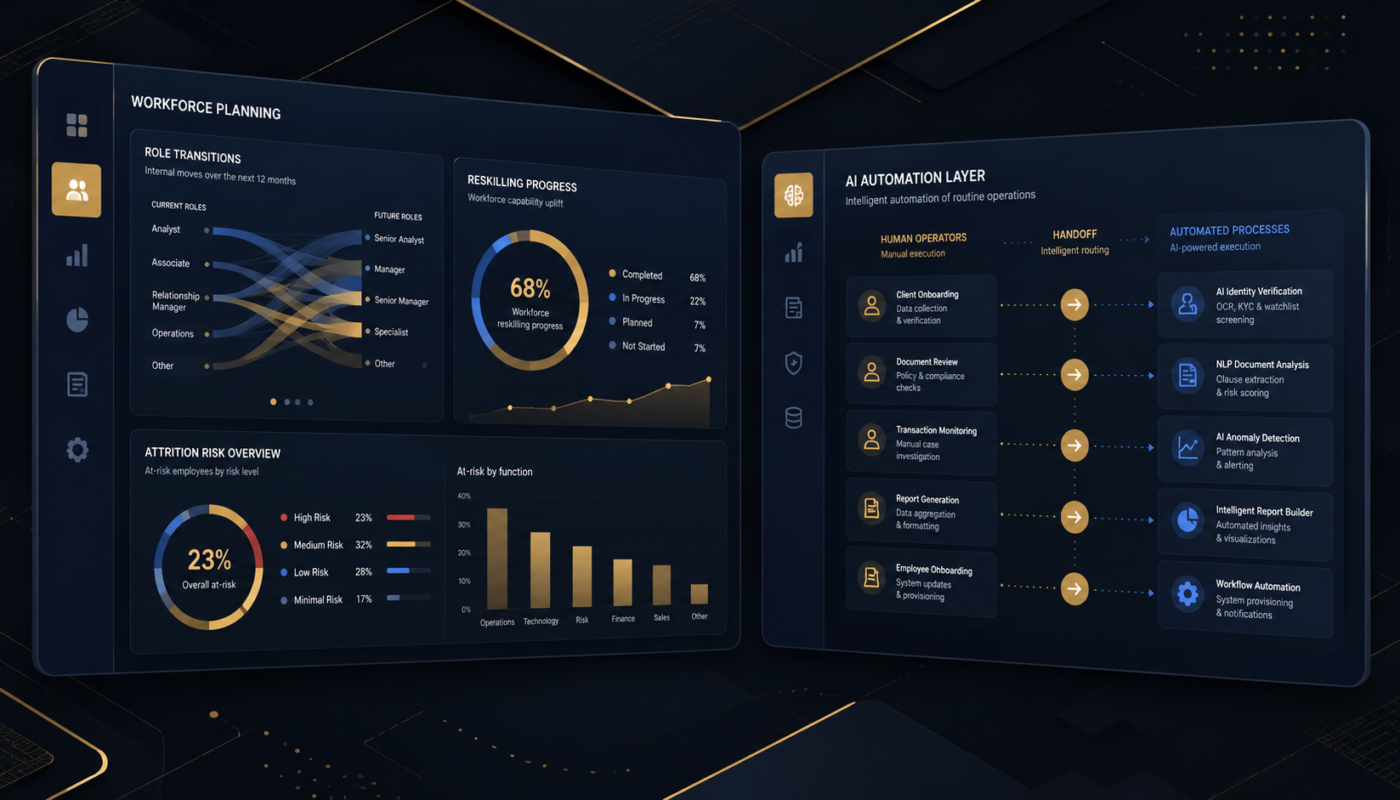
The AI impact on banking jobs is becoming one of the sector’s defining strategic challenges. Wells Fargo CEO Charlie Scharf addressed it directly at a recent financial industry conference, examining how AI is transforming job roles, workflows, and talent strategies, and calling for adaptable HR frameworks in a rapidly changing labour market.
The AI Impact on Banking Jobs: Reskilling and Workforce Transitions
The banking industry has long embraced automation and digital transformation. However, the rapid advancement of AI has brought new challenges that earlier automation waves did not.
Scharf pointed out that AI is taking over routine tasks, which inevitably changes the job descriptions of many employees. Consequently, reskilling and upskilling initiatives have moved from nice-to-have to operational priority. HR departments now play a central role in managing those workforce transitions without harming employee morale or productivity.
This transition is already reshaping how talent teams operate. AI in talent acquisition is forcing recruiters to rethink what counts as sourcing work, and the same execution-to-oversight shift Scharf describes at the banking level is playing out in recruiting workflows across the industry. Additionally, predictive workforce analytics vendors are replacing HR dashboards with forecasting models, giving HR leaders the attrition and skills-gap data they need to plan transitions proactively rather than reactively.
How Banking Job Transformation Creates HR Calibration Challenges
The AI impact on banking jobs is compounded by the sector’s regulatory and data security obligations. Wells Fargo’s experience mirrors broader trends across financial services. Regulatory compliance, data security, and customer trust remain critical constraints, even as AI tools become more widespread.
Scharf acknowledged that deploying AI requires careful calibration to meet those demands. That calibration adds complexity for HR leaders already managing workforce transitions. Recruitment strategies are evolving in response. Specifically, they now prioritise candidates with hybrid skill sets that combine technical expertise with interpersonal abilities.
At the same time, talent retention programmes must address employee concerns about job security and career progression. As pay transparency laws spread across states, compensation band management adds another layer to an already complex HR compliance picture. Furthermore, the broader financial sector context matters: Fiserv’s leadership has positioned AI as a shortcut around core replatforming, a parallel strategic bet that illustrates how financial institutions are approaching the same AI trade-offs from different angles. Meanwhile, bank mergers and consolidation are reshaping financial services innovation strategy, adding further workforce planning pressure on top of AI transition management.
AI and Banking Jobs: Transforming Roles, Not Just Replacing Them
“The challenge for HR is balancing the technological benefits with the human impact,” Scharf explained. “It’s not just about replacing jobs but transforming them in a way that adds value for both employees and the organisation.”
That framing points to a specific need: strategic workforce planning that integrates AI literacy and continuous learning as core components of talent management, not as periodic training exercises.
The engagement dimension is inseparable from that planning challenge. Employee experience platforms are consolidating around continuous listening, and banking HR teams managing AI transitions need exactly that kind of ongoing sentiment signal to catch morale deterioration before it becomes attrition. The identity and access governance risk also deserves attention: AI agents are an identity and access problem that most enterprises are not yet managing, and in a regulated banking environment, that exposure is materially higher than in other sectors.
What the AI Impact on Jobs Means for CHROs and HR Tech Buyers
For CHROs and HR technology buyers, Wells Fargo’s approach serves as both a cautionary and instructive example. Integrating AI requires investment in tooling. However, it also requires a deep understanding of how these technologies change workforce dynamics, and that understanding cannot be outsourced to a vendor.
Vendors offering AI-powered HR solutions should demonstrate capabilities that support seamless upskilling, employee engagement, and compliance monitoring. Organisations that understand the AI impact on banking jobs as a transformation challenge, not just a cost-reduction exercise, will be better positioned to navigate the regulatory landscape and maintain a competitive edge in talent.
The demographic pressure adds urgency to all of it. With 23% of the US workforce now over 55, banking HR leaders face a compounding challenge: managing AI-driven role transformation at the same time as a significant wave of institutional knowledge retirement.